

Shipwreck, Plunder and Betrayal
How the Golden Age of piracy dawned on Florida’s shores
By David Head
At sunrise on December 27, 1715, a band of 65 Spanish men awoke at a place they called Palmar de Ays, likely Orchid Island off Florida’s Treasure Coast, ready to resume salvaging silver from a lost galleon. They quickly discovered they faced something far more dangerous than another day of back-breaking, lung-bursting work: They were surrounded by 150 British pirates.
Henry Jennings and John Wells, captains of the Bersheba and Eagle, led the pirate gang. They were hunting the remains of not one wrecked vessel but 11: the entirety of a Spanish treasure fleet lost in a hurricane the previous summer in the Florida Straits, a 90-mile channel between Florida and the Bahamas connecting the Gulf of Mexico with the Atlantic Ocean.
Sailing along the Florida coast, Jennings showed a pirate’s cunning. Why search for a shipwreck and heave up its cargo—literal tons of precious metals—when they could steal the valuables already neatly packed on shore at the Spanish salvage camp?
As the pirates scoured the shoreline for the camp, Jennings got lucky. He waylaid a Spanish mailboat and forced its captain to reveal the camp’s location. Landing in the wee hours of the morning, Jennings, Wells and their sword-wielding crew advanced on the Spanish.
With pirates far outnumbering his crew, the Spanish commander tried to bargain. He offered the pirates 25,000 pieces of eight (Spanish silver coins) to go away. Jennings made a counteroffer: They’d take everything and the Spanish could stay alive. The Spanish agreed.
Jennings, Wells and their men loaded the loot— worth some 350,000 pieces of eight or about $20 million today—on their ships, sailed for the Bahamas and enjoyed the best pirate Christmas ever.
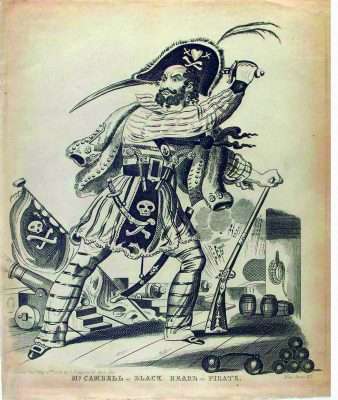
Over the next decade, pirate activity exploded across the Caribbean and the Atlantic in an era that’s come to be known as the Golden Age of Piracy. It was a time when a fearsome figure like Blackbeard might appear on the horizon. Or Bartholomew Roberts, Calico Jack Rackham, Anne Bonny or Mary Read.
Immortalized in novels, plays, movies, video games and their own holiday (International Talk Like a Pirate Day, September 19), these are the freebooters recalled by the word “pirate.” Their boldness and disdain for authority have won them glory and infamy for more than 300 years. And their story began on a sandy stretch of Florida’s coast with a shipwreck and the political intrigue it unleashed.
The Lost Treasure Fleet
The treasure fleet was Spain’s lifeline to its American colonies. Organized in Cadiz, Spain, in 1713 and loaded with European goods for the colonists, this particular fleet crossed the Atlantic and then separated into two squadrons. One headed for Cartagena, in modern Colombia, to drop its bounty and pick up silver mined in Peru. The other delivered its goods to Veracruz, where it collected Mexican silver and gold. The ships would rendezvous in Havana and sail together through the Florida Straits to catch the Gulf Stream home to Cadiz.
Ideally, the fleet sailed once a year, but Europe had been embroiled in the War of the Spanish Succession since 1701 as Britain and its allies opposed King Louis XIV’s bid to unite the crowns of France and Spain. Several costly failures convinced Spanish officials to halt the fleet, but with peace effectively restored in 1714, Spain was ready to send the fleet home with a cargo years in the making: A glittering trove of silver and gold in nearly every form, precious stones, pearls and other treasures.
One ship carried Chinese porcelain, brought across the Pacific by the Manila Fleet to Mexico. Another vessel, the Capitana, stocked 1,300 chests with 3 million silver coins. The Almirante, meanwhile, carried 4.5 million silver coins. All told, the fleet bore cargo worth an estimated 15 million pieces of eight, approximately $800 million today.
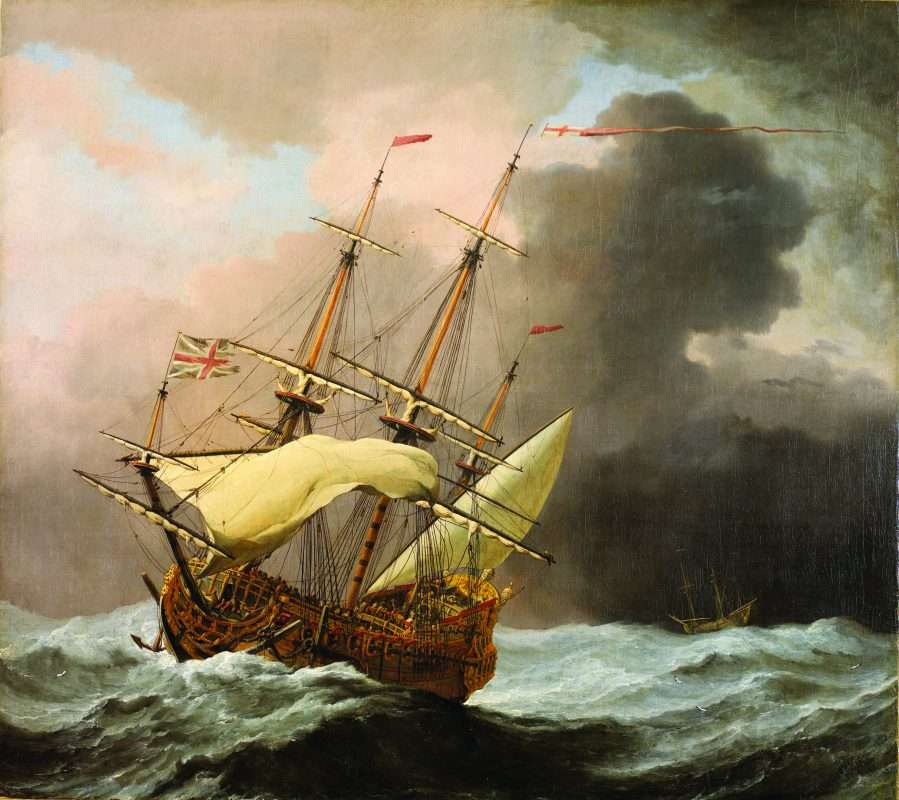
The fleet departed Havana on July 24, 1715, accompanied by a French warship. The ships sailed east under clear skies. But as they turned north into the straits the weather turned, too. A week later, ferocious winds and heaving seas pummeled the fleet, tearing ships apart and driving others into the shoals.
The wreckage was soon strewn along Florida’s coast, from modern Port St. Lucie to Cape Canaveral. Of the 2,500 men who set sail from Havana, more than 1,000 drowned or died from exposure after clambering ashore. Only the French warship, which separated from the rest early in the storm, survived and completed its voyage home, its men unaware of what had happened.
News of the disaster reached Havana in August and officials immediately mounted a rescue and salvage mission. They would’ve preferred to keep their misfortune secret, but there was no chance the loss of the treasure fleet wouldn’t be the talk of every dockside tavern in the Caribbean.
“Fishing the Wrecks”
In the fall of 1715, Port Royal, Jamaica, crackled with an energy absent during the previous decade of war, when the colony’s economy suffered from the loss of trade. Quick riches, the Jamaicans learned, lay submerged only a few days’ sail away.
As the city’s seafarers geared up to “fish the wrecks,” as they put it, the island’s merchants, planters and government leaders took notice—not to restrain the sailors’ greed but to encourage it. Jamaica’s governor, Archibald Hamilton, had the authority to commission privately owned warships, privateers, to attack enemy vessels, carry off their goods, bring them before a court and gain legal title to the cargo as “good prize.” Once sold, the proceeds would be distributed to everyone involved, from the shipowners to the lowliest deckhand.
Technically, privateering existed only during wartime, and Britain and Spain were no longer at war. Governor Hamilton sidestepped that detail by portraying the Spanish commissioned vessels called guardacosta as pirates, enemies of all mankind. Since the end of the War of the Spanish Succession, the guardacosta had seized 37 Jamaican vessels despite the supposed end to hostilities. For Jamaicans, word of the sunken treasure fleet offered a perfect opportunity for revenge—and enrichment.
Hamilton issued 10 commissions, including to Henry Jennings and John Wells. All the privateers understood the real purpose of their ventures. “The wrecks [are] free for everybody,” Hamilton informed one merchant. Even ships without a commission joined in.
The Jamaicans “were all mad to go a wrecking,” wrote a British naval officer who witnessed the frenzy. “They say at Jamaica that the Spaniards are indebted to that Island a considerable Sum of Money & they must repay themselves.” Within just a few months, the Jamaicans were well on their way to repaying themselves from the Florida wrecks.
In late December, Spanish-commissioned privateer Captain Francis Fernando of the Bennet crossed paths near Cuba with the Nuestra Señora de Belén, a former Jamaican ship captured by guardacosta. Recognizing the vessel, Fernando exercised his commission to reclaim it and seize the cargo of 150,000–200,000 pieces of eight, indigo and cochineal, an insect used to make a brilliant red dye. Then, Fernando sailed to the wrecks.
The Jamaicans weren’t alone for long. Ships from across the Caribbean arrived along Florida’s coast: a dozen vessels from Bermuda, two from Martinique, another from Barbados, and a Dutch crew from New York.
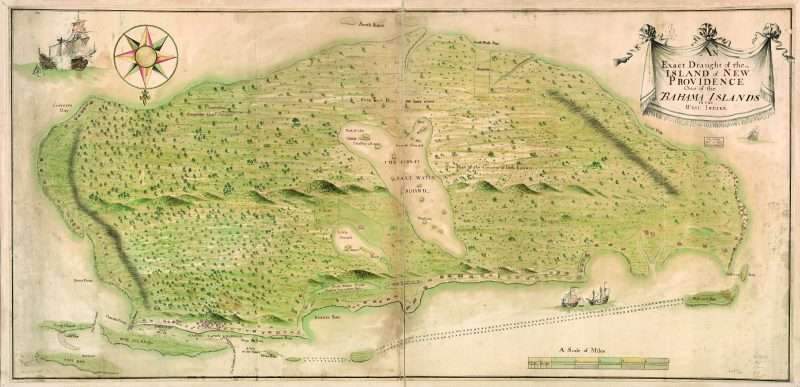
Ships from the Bahamas also sailed to the wrecks—an ominous development, because the islands were ruled by pirates who had stepped in to fill the void when the colony’s British government collapsed during the war.
The Bahamas pirates were led by Benjamin Hornigold, who’d first come to the islands in 1713 following a turn as a privateer out of Jamaica. Little is known about Hornigold’s early life, but he must have been both charismatic and intimidating. He ran off Bahamanian officials, sending the last one packing with a threat to shoot him.
The Jamaicans Betrayed
Governor Hamilton had unleashed a Caribbean-wide free-for-all, and by spring 1716, he knew he’d gone too far. He’d wanted a quick strike to boost Jamaica’s economy and avenge its treatment during the war, while making money for himself and the elites who supported him. But the situation at the wrecks was escalating toward war, and he didn’t want to be the colonial governor who plunged Britain into a new conflict with Spain.
In April, Hamilton recalled all the vessels he’d commissioned and prohibited new ships from sailing to the wrecks. He directed customs officers not to allow any stolen Spanish goods into port. He launched an investigation to discover any wrongdoing that may have contributed to the spiraling hostilities. But Hamilton’s fate was already sealed. He was relieved of his office and summoned to London to explain how a little fishing expedition for sunken treasure had gone so wrong.
Peter Heywood, a Jamaica merchant, replaced Hamilton as governor in July 1716 and continued the inquiry. Its goal was not to find facts but to assign blame. The investigating committee settled on a convenient fiction. The merchants and planters who bankrolled the ships, they decided, bore no responsibility. The real culprits were the captains and sailors who had, conveniently enough, devised the raids all on their own.
Heywood accepted the committee’s findings and issued a warrant for the arrest of some 300 seafarers. Later, another proclamation demanded all men involved in fishing the wrecks turn themselves in or be declared pirates. Only a handful of elites received even a small punishment.
Threatened with piracy charges, the Jamaican sailors headed for the Bahamas, where pirates ruled. Burned by the shabby treatment by their homeland, they swore off their loyalty to Britain and embraced a new identity as men beyond the law.
The influx of angry newcomers destabilized the Bahamian pirate community. Hornigold and others, like Jennings, felt a connection to their king, even if they occasionally captured a British ship or two. After 1716, however, a new generation took power, bent on warring against the world and seizing ships regardless of their flag.
One of Hornigold’s lieutenants, Edward Thatch, soon to be immortalized as Blackbeard, embodied the new attitude. He plundered British ships, including the Protestant Caesar of Boston, and blockaded British ports like Charles Town, South Carolina. Another lieutenant, Sam Bellamy, broke from Hornigold when he demurred from capturing more British ships. He sailed from the Bahamas and ravaged the New England coast before dying in a shipwreck.
Charles Vane was another former wreck fisher who turned into a vicious pirate captain. After refusing a pardon offered by the Crown, he fired on the Royal Navy and attacked French and British ships. He was shipwrecked, but survived on an island off Honduras until he was picked up by a British vessel, taken to Jamaica, tried and hanged, with his remains gibbeted in the harbor for all to see.
Piracy spiraled out of control. New sailors joined crews alongside the wreck-plundering veterans, cruising the Atlantic as far north as Newfoundland, south to Brazil, and east to Africa.
The Golden Age of Piracy was underway, thanks to a storm that drove a bonanza of riches onto Florida’s shores. What we now call Florida’s Treasure Coast should, perhaps, be better remembered as the Pirate Coast.

David Head is a historian at the University of Central Florida, whose books include Privateers of the Americas: Spanish American Privateering from the United States in the Early Republic and The Golden Age of Piracy: The Rise, Fall, and Enduring Popularity of Pirates. The article is adapted from his Florida Talks program “Pirates Hunting Sunken Treasure: How a Florida Shipwreck Sparked the Golden Age of Piracy.” He is part of the Florida Talks speakers bureau hosted by Florida Humanities.