

Lights, Camera, Jacksonville
Before there was Hollywood, there was Jacksonville, and the city’s historic theaters are its icons.
By David Morton
On May 3, 1901, the largest fire in the history of the American South destroyed nearly all of downtown Jacksonville. In just eight hours, the blaze reduced Florida’s first metropolis to a smoldering ruin, tearing through 146 city blocks, leveling 2,300 buildings, and leaving nearly a third of the city’s roughly 28,000 residents homeless.
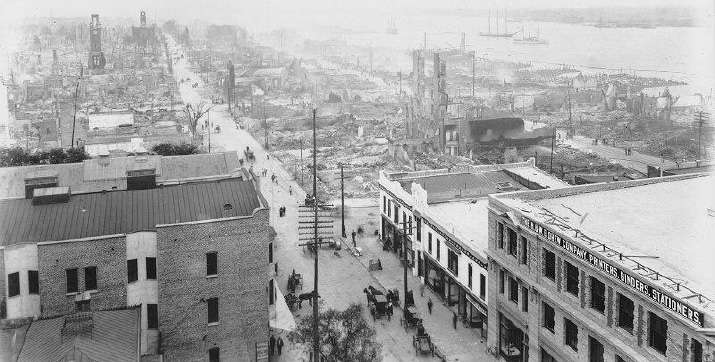
But Jacksonville was destined to rise from the ashes of the Great Fire of 1901 as the nation’s film capital, spawning a construction boom of glittering theaters that provided entertainment for generations.
Just three days after the fire, the first building permit was approved for construction—a temporary house of worship for the B’nai Israel Congregation. And within the next two years, over 2,000 brick, steel and stone buildings replaced a downtown that had consisted mostly of low-rises built from easily combustible pine flatwoods.
Ten years on from the Great Fire of 1901, Jacksonville’s population skyrocketed to nearly 58,000 as the city evolved into a leading Southeast trade and manufacturing hub. Jacksonville’s rapid growth brought new attractions, including the 21-acre Dixieland Park, completed in 1907 on the south bank of the St. Johns River. Dubbed “The Coney Island of the South,” the park had a roller-coaster, a 160-foot waterslide, and the Dixieland Theatre, which hosted vaudeville acts, silent films and opera.
The following winter, Dixieland Park gained new neighbors on the opposite side of the St. Johns, when the Kalem Company, a silent film studio based in New York City, set up its winter headquarters at The Roseland Hotel. Between December 1908 and March 1909, Kalem produced 18 short films in Florida, including a series of Civil War dramas and sensational stories set in the state’s backwoods. During the next winter season, several film companies joined Kalem, including Chicago-based Selig Polyscope and Philadelphia’s Lubin Manufacturing. At a time when Hollywood, California, was best known for its orange groves, Jacksonville had become “The World’s Winter Film Capital.”
The architect of entertainment
With film production entrenched in the local economy, a theater building boom soon followed.
Roy A. Benjamin would become one of the architects who defined that boom. He was just 14 years old in 1901 when his father, an entrepreneur with a hand in grocery stores, railroads and other businesses, moved his family from Ocala to Jacksonville in search of opportunities in the growing city.
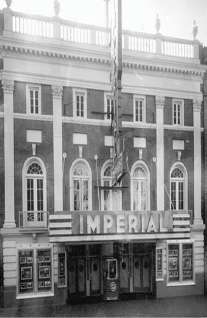
Rather than follow in his father’s footsteps, the younger Benjamin dropped out of school and apprenticed with architectural firms in Savannah and later New York. He returned to Jacksonville in 1911 and opened an office on Forsyth Street, where he received his first contract: to design the Imperial Theatre.
When the Imperial opened that May, General Manager N.W. Redmond boasted to The Florida Times-Union, “Our aim is to entertain the public with the very best moving pictures, music, and singing … none but the very best comedy, drama, educational, and spectacular subjects will be exhibited!”
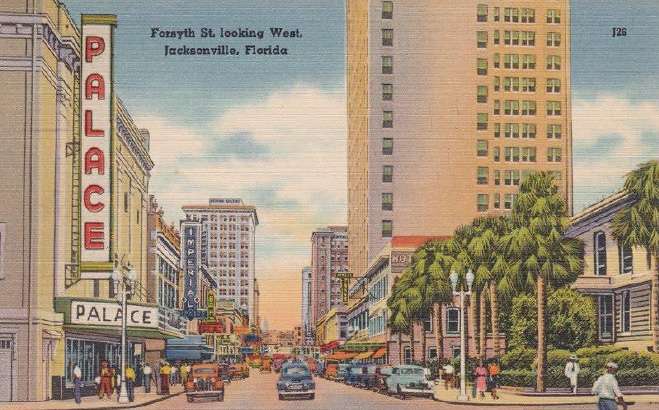
The Imperial became a key fixture on Jacksonville’s growing Theatre Row along Forsyth Street between Main and Newman streets. Nearby stood its sister theater, The Empress, and a block away The Duval Theatre hosted both vaudeville and motion picture screenings.
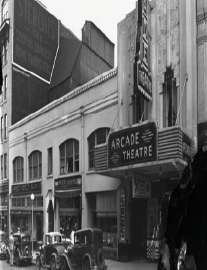
Benjamin oversaw the design of several more theaters throughout the city, including the 1,250-seat Arcade Theatre on Adams Street and The Palace Theatre on West Forsyth.
Nicknamed “The Theatre Beautiful” and celebrated as “Equal of any and peer of many in the East,” the 1,900-seat Palace served as an important stop along the prestigious Keith Vaudeville circuit. After the Palace was completed, Benjamin accepted a lucrative contract to design theaters in Dallas and left Jacksonville for a brief Texas sojourn.
The Harlem of the South
At the time of the Great Fire of 1901, African Americans comprised nearly 60 percent of Jacksonville’s population. Opportunities to rebuild the city after the fire helped the community develop a highly educated, politically active and prosperous middle class.
Despite that progress, Jacksonville remained heavily segregated. Black theatergoers could attend live performances and movies at certain downtown venues, but only from the upper-balcony “nosebleed” section. They purchased tickets at separate windows and entered through side alleys or designated back doors.
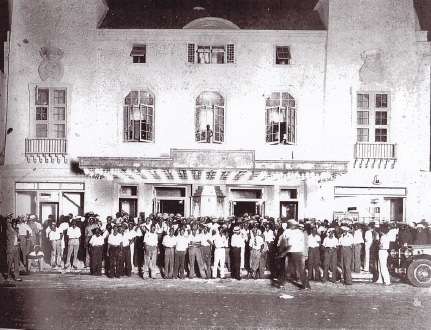
In response to the Jim Crow indignities of “The Great White Way,” Black leaders built a strip of theaters for the community several blocks north of Forsyth Street in the LaVilla neighborhood. Unlike the theaters on Forsyth, Ashley Street’s venues were technically integrated, with a small number of white patrons enjoying live music, vaudeville performances and movies in a shared space with Black audiences.
Ashley Street’s lively music scene and café culture helped connect LaVilla to a national network of African American activists, artists and entertainers. One of its best-known venues, The Colored Airdome on West Ashley Street, boasted an open-air audience capacity of 800 seats, advertising screenings and performances “in positively the largest, grandest and coolest theater exclusively for colored people in the entire Southland.”
LaVilla’s influence extended well beyond Jacksonville. It was at the Colored Airdome that the first published account of a blues performance took place on a public stage—a decade before Beale Street became the home of the blues and Lenox Avenue helped inspire the Harlem Renaissance.
“LaVilla has been called the Harlem of the South, when it’s Harlem that should be called the LaVilla of the North,” Jacksonville urban historian Ennis Davis once remarked.
The visionary behind Ashley Street’s thriving theater district was former barber Frank Crowd. After the Great Fire destroyed his shop he rebuilt his business within a week. In 1908, he turned to a new venture, opening the Bijou Theatre, the neighborhood’s first movie house. The Bijou soon hosted one of the earliest feature movie premieres in Florida: “The Life of Moses,” produced by J. Stuart Blackton and the Vitagraph Company of America.
Facing fierce competition from the Colored Airdrome next door, Crowd invested $25,000 to remodel his theater with a balcony, slanted floors, and a state-of-the-art lighting system. He reopened the venue as The Globe Theatre, which hosted its own stock theater company and featured legendary early blues icons like Ma Rainey, who performed there to packed encores night after night, and Jelly Roll Morton, the father of jazz.
The success of Ashley Street’s theater district soon drew new competitors to LaVilla. In June 1915, entrepreneur H.S. Walker opened the Strand Theatre, “amid the glare of blazing lights, a blaring of brass bands and a crowd in gala attire,” reported The Indianapolis Freeman. Patrons, the newspaper noted, “lined Ashley Street and pushed and surged like a rolling sea.”
With his deep pockets, Walker was able to attract travelling theater companies, including the Russell-Owens Stock Company, which ensured the Strand would outperform any of its rivals on Ashley Street. By the end of 1915, the Colored Airdome had been run out of business, and the following year Frank Crowd’s Globe Theatre closed for good.
Plot shift
The turning point for Jacksonville’s entertainment industry came in 1917 with the election of conservative Mayor John W. Martin, who ran on a platform to rein in alleged city-wide disruptions caused by the so-called “movie people.” Martin’s election prompted the nearly 30 studios operating in the city to pack up and head west to Hollywood.
One prominent holdout was architect Henry Klutho, who’d moved to Jacksonville from New York after the Great Fire to help rebuild the city. He went on to reshape the Jacksonville skyline with landmarks in Frank Lloyd Wright’s Prairie Style, including the Bisbee Building, the Jacksonville Free Public Library, and the St. James Building, considered Klutho’s Prairie School masterpiece and now Jacksonville City Hall.
Klutho saw another opportunity when the Kalem Company left town. He purchased their abandoned equipment and invested over $40,000 of his own money to build a state-of-the-art studio complex. He envisioned the $1 million Fine Arts City as the world’s largest studio complex, modeled after the self-contained studio cities in Southern California. But facing resistance from Mayor Martin and lukewarm support from the Jacksonville Chamber of Commerce, Klutho was unable to secure investors. By 1922, he had abandoned his dream of a Fine Arts City, and his studio was permanently shuttered.
A second act
While Jacksonville’s standing in the mainstream film industry significantly diminished after the failure of Fine Arts City, the cameras continued rolling on the other side of the St. Johns River at Eagle Studios in Arlington. In 1920, itinerant movie producer Richard E. Norman bought the property and established the Norman Film Manufacturing Company, the first motion picture studio to produce “race films” for African American audiences.
Norman teamed up with Buddy Austin from the Strand Theatre to recruit talent for his films, which portrayed Black characters as ambitious, highly accomplished professionals. His films were extremely popular with African American audiences throughout the South and regularly featured in Ashley Street’s theaters. Norman’s most famous film, “The Flying Ace,” released in 1926, was selected for preservation by the Library of Congress in 2021.
Like many independent studios, Norman’s company was unable to make the transition to sound films. He instead shifted to operating several independent movie theaters, including the Ace Theatre in Apopka and the Famous Theatre in Winter Park. Norman traveled throughout Florida screening his films at African American schools and churches until his death in 1960.
Even as Jacksonville’s moviemaking dreams faded out of frame, the city’s theater districts continued to grow. By the early 1920s, there were 24 nickelodeons and theaters in downtown Jacksonville alone.
The palace builder returns
In 1922, the year Fine Arts City closed, Roy A. Benjamin returned to Jacksonville from Texas. Five years later, he finished construction on the Riverside Theater on Park Street. Designed in an Italian Renaissance style, the Riverside was the first movie theater in Florida and only the third in the country wired for synchronized sound. The Riverside opened with a special screening of “Don Juan,” the first film to use a synchronized musical score. Tickets for the event were $1.10, considered astounding at the time— about $20 today.
That same year, Benjamin also completed his most famous work: the Florida Theatre on East Forsyth Street. With its lavish Mediterranean Revival architecture, intricate detailing, and grand auditorium, Benjamin’s masterpiece hosted not only film screenings but live concerts, including six performances by Elvis Presley in August 1956.
Benjamin went on to become one of the nation’s most prolific theater architects, designing venues including the Sarasota Opera House (1926) and iconic Jacksonville theaters such as the San Marco (1938), the Brentwood (1941), and the Fairfax (1941).
Today, only two of Benjamin’s Jacksonville theaters remain active performance venues: the Florida Theater and Riverside Theater, now a music venue called FIVE.
Star power in LaVilla
LaVilla’s Ashley Street continued to grow during the 1920s and 1930s as Jacksonville emerged as an essential stop along the Chitlin Circuit, the national network of performance venues where Black entertainers performed.
New venues followed. In 1925, the Strand gained a neighbor with the opening of the Frolic Theater, which hosted several high-profile movie screenings, including the Florida premiere of African American filmmaker Oscar Micheaux’s “The Millionaire” (1927). Four years later, the Ritz Theatre opened at the corner of State and Davis streets, several blocks north of Ashley Street. Designed in a striking Art Deco style by Jacksonville architect Jefferson Powell, the 970-seat theater soon eclipsed the Strand as LaVilla’s premier performance venue.
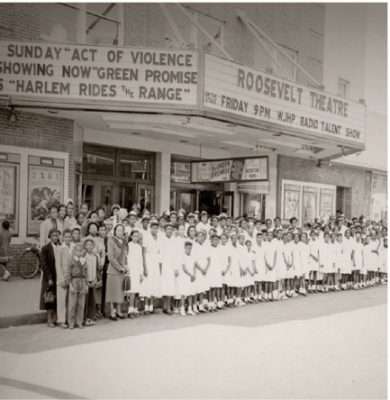
From the 1930s through the 1960s, the Ritz hosted a roster of legendary performers including Louie Armstrong, Cab Calloway, Ray Charles, Duke Ellington, Ella Fitzgerald, Billie Holiday and Dionne Warwick. LaVilla reached its peak in 1949 with the opening of the 1,150-seat Roosevelt Theatre, which served as an anchor for the thriving neighborhood.
The curtain falls
By the 1960s, urban renewal and the construction of Interstate 95 had taken a heavy toll on LaVilla’s once-lively theater district. The Strand closed its doors in 1968 and was destroyed by a fire the following year, and the Frolic and Roosevelt theaters were eventually demolished. The Ritz shuttered in 1972 and was demolished, but the concerted advocacy of urban preservationists helped secure $4.2 million from the River City Renaissance restoration program to rebuild the historic venue. A new 422-seat Ritz Theatre and Museum rose on the same site, dedicated to “research, record, and preserve” the rich cultural legacy of Jacksonville’s African American community.
Today, the Ritz joins the Florida Theatre, FIVE, and Theatre Jacksonville (the nation’s oldest continuously operating theater group) as enduring reminders of a city that once rivaled Hollywood as it helped shape America’s early film and entertainment industry.
David Morton received his Ph.D. in Texts and Technology from the University of Central Florida in 2019, where he also is an instructor in both History and Media Studies. He was a recipient of the 2016-17 Fulbright scholarship and serves as program director for the Flickering Landscapes Conference Series. His book, A Motion Picture Paradise!: A History of Florida’s Film and Television Industry was published by the University Press of Florida in 2024. He is part of the Florida Talks speakers bureau hosted by Florida Humanities.