

The Seminole Story, Preserved
Photographs, maps, art and other objects in the Ah-Tah-Thi-Ki Museum document the remarkable history of the Seminoles.
By Tara Backhouse, Ah-Tah-Thi-Ki Museum curator
Artwork, maps, clothing, canoes, letters, newspapers, documents, postcards and photographs. These are among the nearly 200,000 artifacts in the Ah-Tah-Thi-Ki Museum that reveal thousands of years of Seminole heritage. From oral histories that show connections to the region’s earliest inhabitants to official records documenting tribal sovereignty, the collection preserves not only objects but also the experiences, resilience and creativity of the Seminole people.
Held in perpetuity for the Seminole Tribe with a mission to serve the Indigenous communities of Florida, the collection shares the story and culture of the Seminoles in onsite exhibits, community events, publications and other venues.
Many items in the collection were created by people in the Seminole community and other southeastern Indigenous groups. Others were created by non-Indigenous people.
Together, the archives trace a remarkable story of survival—from European invasion and military conflict to life in the Everglades, the rise of tourism, and the emergence of the Seminole Tribe as a modern sovereign nation.
A Homeland Claimed by Empires
Each Seminole era is represented in the historic collection by a multitude of objects rather than a single defining piece of history. Maps, letters, newspaper clippings, government documents and other records tell the story of the Seminoles’ long struggle with invaders who crossed an ocean and claimed lands Indigenous people had inhabited for thousands of years.
The first Europeans arrived in the region in the early 1500s. The Spanish named the land “La Florida” and fought the French for control, with no regard for the rights or culture of the Indigenous people they encountered.
Documentation of this period in the Ah-Tah-Thi-Ki archives includes a Spanish map from 1584, reprinted in a French publication, accompanied by this description:
“Florida is a section of the Northern American hemisphere: It is called this way because of the day of the flowered Easter, when Spaniards first touched ground, known as the day of our salvation 1521. … It was named this way because it (Florida) was so green and flowery. The French however tried to make it a colony and send people over to develop it. But they were not able to do so since the Spaniards chased them away several times. The natives are barbaric, foul and inhuman. They eat spiders, lizards, snakes and other poisonous beasts. The province is itself pretty fertile, and quite abundant in gold.“
The Spanish ruled most of the peninsula for nearly 300 years. During that time they attempted to assimilate Indigenous people into Spanish society while waging war against those who resisted. After Great Britain’s victory in the French and Indian War, Spain ceded Florida to the British in 1763 in exchange for control of Cuba.
Unlike the Spanish, the British pursued trade agreements and diplomacy in their approach to Indigenous people they encountered. A clipping from The Boston Chronicle for the week of April 11, 1768, includes reports of trade between the tribes and the British.
In 2006, the Ah-Tah-Thi-Ki museum acquired a letter written in 1774 by John Moultrie, Governor of East Florida, to “The Cowkeeper and other Headmen and Warriors,” asking for a meeting to discuss conflicts in the region. Moultrie promised that “if any of you have a mind to talk like a friend, come to me you shall be safe. Not a hair of your head shall be touched.” Cowkeeper was the first known Indigenous leader the Europeans identified as Seminole, a term they used to refer to all native people living in Florida at the time. His descendants include the namesakes for the town of Micanopy and the Payne’s Prairie wetland, a National Natural Landmark, near Gainesville.
Moultrie’s promise, like the promises of many treaties that followed, were not kept.
British rule lasted only 20 years. As part of the 1783 Treaty of Paris ending the Revolutionary War, Britain officially returned Florida to Spanish rule.
But the young United States, eager to expand its territory, soon sought control of Florida, creating conflict in the Indigenous south and launching the Seminole Wars.
Records of Resistance
American history generally splits the Seminole wars into three separate conflicts: the First Seminole War from 1817 to 1818, the Second Seminole War from 1835 to 1842 and the Third Seminole War from 1855 to 1858. But for those under attack it felt like one long battle.
The Ah-Tah-Thi-Ki archives hold thousands of newspaper accounts, letters, government records and military reports from the years of the Seminole Wars. Viewed in the context of Seminole voices and artifacts of the same era, the documents reveal distortions in how history was recorded.
An article published in the Richmond Inquirer in 1823, ostensibly between wars, reports on plans by the U.S. to build a road between Pensacola and St. Augustine through Indigenous lands without first consulting the Indigenous people it would displace. As the commentary on the article in the museum’s online archive notes: “There was no room for Tribal Sovereignty when it was in the way of the United States’ manifest destiny.”
Even in times of official peace, Indigenous people remained under pressure from U.S. expansion, never truly free from the threat of removal.
Newspaper clippings in the Ah-Tah-Thi-Ki archives include letters published in 1818 in Baltimore’s Niles’ Weekly Register that describe General Andrew Jackson’s movements through Florida, including his struggles with provisions and starvation. The letters diminish Indigenous people and focus instead on Jackson’s campaign and the destruction left in his wake. During the First Seminole War, he burned villages to the ground and negotiated with a matriarch he referred to only as the “old woman of the party,” a phrase that revealed his lack of interest in learning her name or understanding Indigenous social structures.
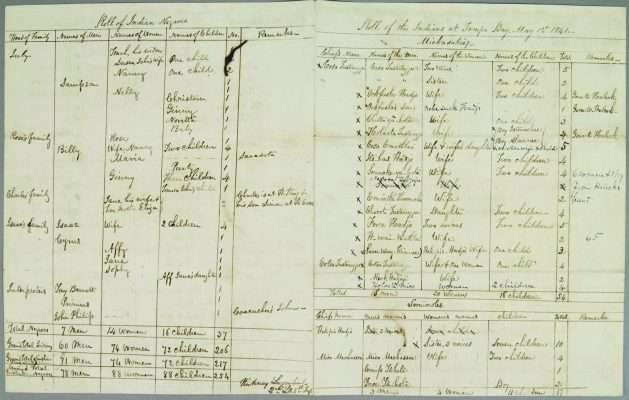
During the second period of conflict, the U.S. Army forcibly removed thousands of Seminole people and their allies from Florida. Among the official U.S. government records in the Ah-Tah-Thi-Ki collection is a hand-written register documenting people held at Fort Brooke in Tampa before they were taken by boat to New Orleans. From there, they were forced to travel to present-day Oklahoma, where the Seminole Nation of Oklahoma is now located.
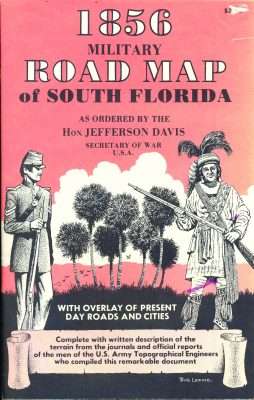
The Ah-Tah-Thi-Ki archive also includes a 1975 souvenir reprint of a wartime map from 1856 showing both Indigenous camps and U.S forts. Its publication as a keepsake demonstrates how military campaigns against Indigenous people were long remembered as patriotic accomplishments rather than acts of war and genocide.
Life in the Everglades
The so-called Third Seminole War ended in 1858 when Chief Billy Bowlegs agreed to relocate west. A Harper’s Weekly article from 1858 in the museum’s collection includes an interview with Bowlegs in New Orleans, conducted while he was being sent to Oklahoma. The article describes the chief as “savage” and refers to his daughters as “marriagable,” revealing the racism and entitlement in many contemporary accounts.
Still, even after the massive relocation, a few hundred Indigenous people remained in Florida, largely in the Everglades.
Among the documents preserved in the museum is a copy of an 1842 bill introduced by the U.S. Congress to explore draining the Everglades. Various reasons were given for the proposal, including making Florida land more profitable through expanded agriculture. But a primary motivation was to “solve the Indian problem.’’ Proponents of the idea knew that draining the Everglades would make colonial settlement possible in the interior of Florida and, they assumed, finally drive all the Indigenous people from their homeland.
Newspaper clippings in the museum archives on this topic include an 1881 article from the Pittsburgh Commercial Gazette. The article announced a deal the state of Florida struck with Philadelphia business owners to create a company to drain the Everglades and clear 10 million to 12 million acres. In return, the company would take ownership of half of the cleared land.
The new government tactics pushed the Seminole people farther into the Everglades and restricted the area in which they lived. Efforts to drain the Everglades began in earnest in 1882. By the end of the 20th century’s first decade, the land was irrevocably changed.
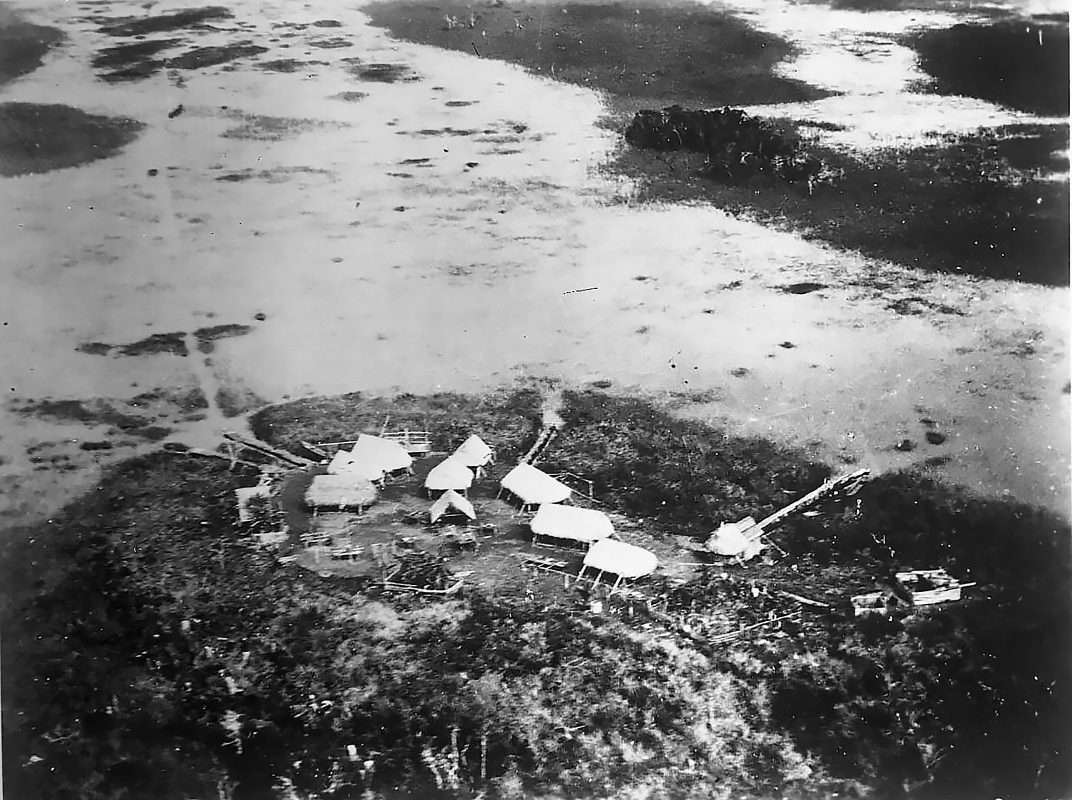
Prior to drainage, the region was a rich watery ecosystem. Residents lived on dry outcrops called hammocks and remained connected to other Seminole communities, crossing the wetlands by canoe and sharing resources. They sustained themselves and their neighbors with the plants and animals of the Everglades and traveled to trading posts on the coasts for anything they could not get from the land.
Hundreds of postcards and photographs in the museum’s collection document a turning point in Seminole history. As drainage projects transformed the Everglades and canoe travel became restricted, camps grew more isolated and the traditional ways of Everglades subsistence living slowly faded away. The Seminoles adapted by transitioning to tourism, emerging as an early leader in this sector of the state’s economy.
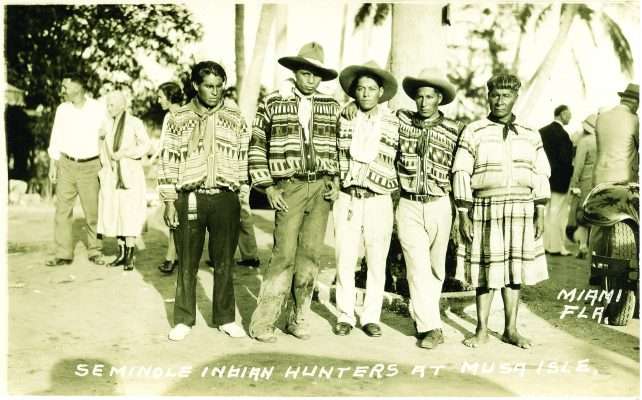
The Ah-TahThi-Ki collection includes postcards from Musa Isle, a popular “Indian village” in Miami where tourists paid to experience Seminole culture and Florida wildlife. Other photographs document camps that moved close to the newly opened Tamiami Trail, connecting Tampa to Miami in 1928, to increase their access to tourists. In their villages, the Seminoles sold patchwork, beadwork, dolls, baskets and other art work, much of it represented in the archives.
A swatch of red broadcloth is among the collection’s artifacts, a reminder that trading still occurred at coastal posts where Seminole and non-Seminole people exchanged goods. Seminole men bargained for cloth, sewing machines, coffee, flour and sugar, offering in return animal skins and bird feathers they collected in the Everglades. Their colorful clothing became so well known that word spread quickly through neighboring towns when they arrived to trade.
The Making of a Sovereign Nation
As tourism flourished in Florida, the time of adjustment was moderately prosperous for the Indigenous people. But in the mid 20th century, the landscape changed again. This time, it was the political landscape.
State and federal legislation had established land for the Seminole Tribe including the Hollywood Reservation in 1926 and the Big Cypress and Brighton reservations in 1936. Then, in 1953, the U.S. Congress approved The Indian Termination Policy, which aimed to assimilate Indigenous people by ending federal support of reservations and recognition of tribes. Faced with this devastating proposition, the Seminole tribe mounted legal challenges. In 1957, they officially formed a federally recognized government cementing their status within the U.S. system.
The first tourism business that the newly formed Tribe opened was Okalee Indian Village on the Hollywood Reservation in 1960. It featured a recreation of a traditional Seminole village, as well as animals in enclosures, a snack bar and a gift shop.
An iconic larger than life statue of alligator wrestler Jackie Wille and an alligator stood in front of Okalee Indian Villager on Route 441 in Hollywood Florida during the 1960’s and 70’s
In 1979, the Tribe pioneered the Native American gaming industry with a high-stakes bingo hall in Hollywood, now the Seminole Classic Casino. The Ah-Tah-Thi-Ki’s bingo cards, audio recordings of the state legislature, and newspaper articles in the Seminole Tribune provide insight into this pivotal moment in Seminole history.
Even as gaming took off in the state, the Seminoles’ tourism enterprises continued to thrive. Bobby’s Seminole Village opened in 1982 in Tampa, Billie’s Swamp Safari in Clewiston in 1993, and in 1997, the Ah-Tah-Thi-Ki Museum itself on the Big Cypress Reservation.
Among the modern records preserved in the Ah-Tah-Thi-Ki Museum is memorabilia from the 50th anniversary of the Seminole Constitution, celebrated in 1987. The event is immortalized in the collection with an invitation to the event, a program of festivities that features a picture of the first Tribal Council, the preamble to the Seminole Constitution, and a poem by Moses Jumper, Jr., titled “The Council Oak.”
Living History
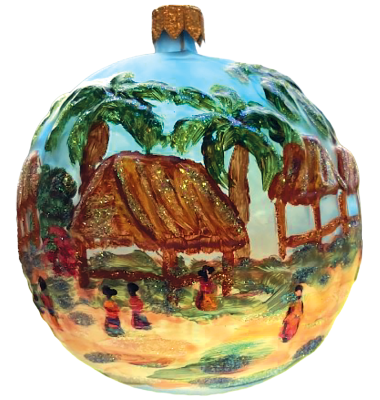
Today the Ah-Tah-Thi-Ki Museum continues to capture Seminole history as it unfolds. Archives of the Seminole Tribune preserved at the museum include 2026 stories on the expansion of the Hard Rock Casino, a native healthcare conference and FSU basketball player Xavier Osceola.
The museum also exhibits the work of contemporary Seminole artists, such as Elgin Jumper, who explores historic and modern themes with the magical realism he finds in everyday life.
Together, these photographs, documents, artworks and artifacts tell a story that is at once surprising and inspiring: a people who endured invasions, war, forced removal and environmental transformation while maintaining their culture, identity and sovereignty. Preserved in the Ah-Tah-Thi-Ki archives, this history remains a living record that grows with every generation.